Factorising difference of squares
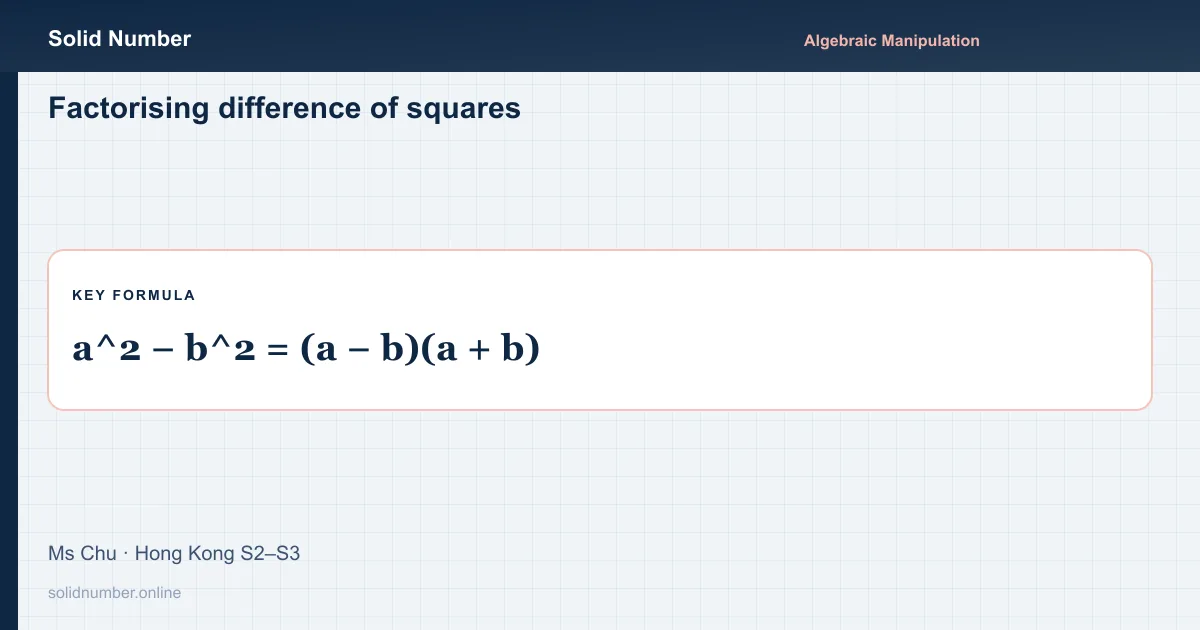
Recognise a² − b² instantly and factor as (a − b)(a + b), including with coefficients.
Key formulas
Spotting the pattern
Both terms must be perfect squares separated by a minus. Sum of squares a² + b² does not factor over the reals in junior secondary work.
Coefficients and powers
Write each term as a square: 4x² = (2x)², 25 = 5². Higher even powers may factor more than once: x⁴ − 16 = (x² − 4)(x² + 4) = (x − 2)(x + 2)(x² + 4).
Combined with common factors
Take out a common factor first: 2x² − 32 = 2(x² − 16) = 2(x − 4)(x + 4).
Exam habit
Ask: “Are both parts squares? Is the sign minus?” before writing factors.
Worked example
Difference of squares
Problem. Factorise 16x² − 49.
Solution. (4x)² − 7² = (4x − 7)(4x + 7).
Review quiz
1 / 4x² − 49 =
Practice questions
- Factorise x² − 49.
- Factorise 9y² − 1.
- Factorise 3x² − 27.
Study notes
Can x² + 16 be factorised?
Not into real linear factors in the S2–S3 syllabus.
Order of factors?
(a − b)(a + b) or (a + b)(a − b) are both correct.