Rational numbers: fractions, decimals and recurring decimals
Convert between fractions and decimals, recognise recurring decimals, and keep rational arithmetic organised.
Key formulas
What makes a number rational
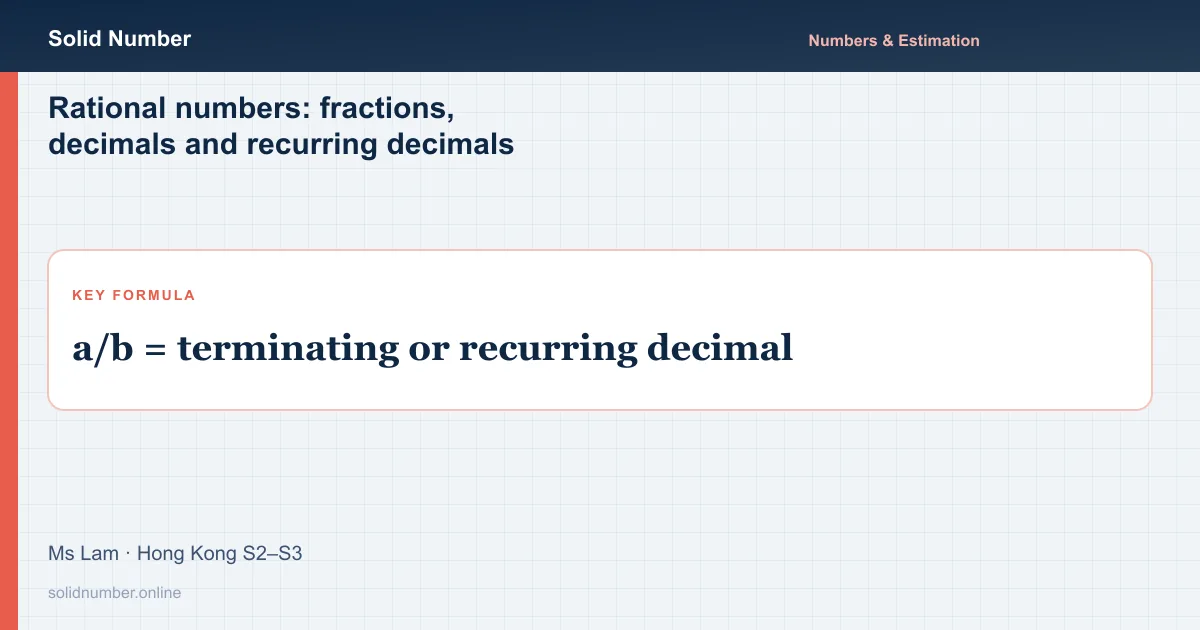
A rational number can be written as a fraction a/b where a and b are integers and b ≠ 0. Terminating decimals and recurring decimals are both rational; non-recurring infinite decimals such as √2 are not.
Fraction–decimal conversion
Divide numerator by denominator to get a decimal. If the remainder eventually repeats, use a dot notation over the repeating block. To convert a recurring decimal back to a fraction, use the place-value equation method taught in Secondary 2–3.
Operations with fractions
Add and subtract only after a common denominator. Multiply numerators and denominators; divide by multiplying by the reciprocal. Cancel common factors early to keep numbers small.
Exam habit
Leave answers as simplified improper fractions or mixed numbers exactly as the question asks — do not mix forms without reason.
Worked example
Recurring decimal to fraction
Problem. Express 0.\dot{4} as a fraction in simplest form.
Solution. Let x = 0.444…. Then 10x = 4.444…. Subtract: 9x = 4, so x = 4/9.
Review quiz
1 / 47/8 as a decimal is
Practice questions
- Express 7/8 as a decimal.
- Write 0.\dot{6} as a fraction in simplest form.
- Calculate 2/5 + 3/4 and 5/6 ÷ 2/3.
Study notes
Is every decimal rational?
No. Only terminating or recurring decimals are rational.
Should I use a calculator for recurring decimals?
Use exact fraction methods unless the paper allows calculator rounding.
More in Numbers & Estimation
- Directed numbers: add, subtract, multiply and divide
- Approximate values and sensible estimation
- Prime factorisation, HCF and LCM
- Scientific notation and large/small numbers
- Directed numbers with brackets (challenge)
- Ordering directed numbers on the number line
- Absolute value of directed numbers
- Four operations mixed with directed numbers