Scientific notation and large/small numbers
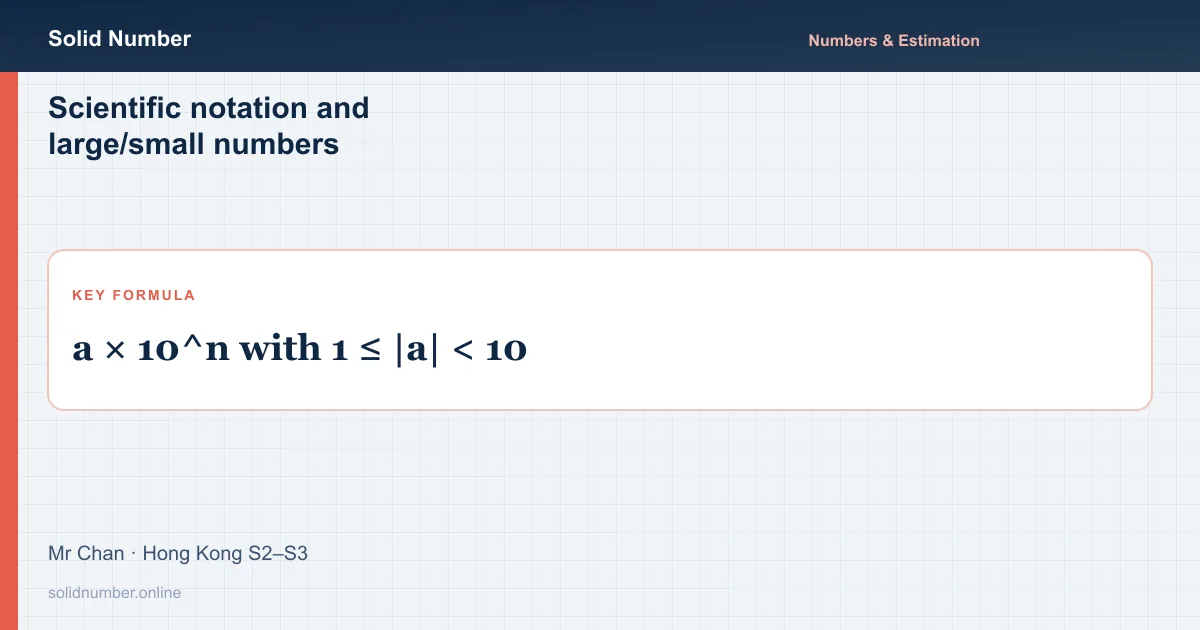
Convert between ordinary form and a × 10ⁿ with 1 ≤ |a| < 10 — standard S3 index work.
Key formulas
Standard form
Scientific notation writes a number as a × 10ⁿ where the absolute value of a satisfies 1 ≤ |a| < 10 and n is an integer. Move the decimal point until that condition holds; n counts how many places you moved.
Large and small numbers
Numbers greater than or equal to 10 use a positive index. Numbers between 0 and 1 use a negative index. Keep a to a sensible number of significant figures as the question requires.
Operating in scientific notation
Multiply or divide the a-parts, then add or subtract the indices of 10. Renormalise if the new coefficient falls outside [1, 10).
Exam habit
Underline the final decimal point position. Reject answers like 36 × 10⁴ — rewrite as 3.6 × 10⁵.
Worked example
Convert and multiply
Problem. Write 458000 in scientific notation and evaluate (3×10^4)×(2.5×10^{−2}).
Solution. 458000 = 4.58×10^5. Product: 7.5×10^{2} = 750 after renormalising 7.5 already in range.
Review quiz
1 / 40.00058 in scientific notation is
Practice questions
- Write 0.00058 in scientific notation.
- Write 7.25 × 10⁴ in ordinary form.
- Calculate (2 × 10³) × (3.5 × 10⁴) and give the answer in scientific notation.
- Express 0.00402 × 10⁵ in scientific notation.
Study notes
Can a be negative?
Yes for negative numbers, but school questions usually use positive a.
Is 10 × 10³ allowed?
No — rewrite as 1 × 10⁴.
More in Numbers & Estimation
- Directed numbers: add, subtract, multiply and divide
- Approximate values and sensible estimation
- Rational numbers: fractions, decimals and recurring decimals
- Prime factorisation, HCF and LCM
- Directed numbers with brackets (challenge)
- Ordering directed numbers on the number line
- Absolute value of directed numbers
- Four operations mixed with directed numbers