Negative indices and positive-index answers
Simplify products and quotients with negative indices, then rewrite with positive indices as papers usually demand.
Key formulas
Definition first
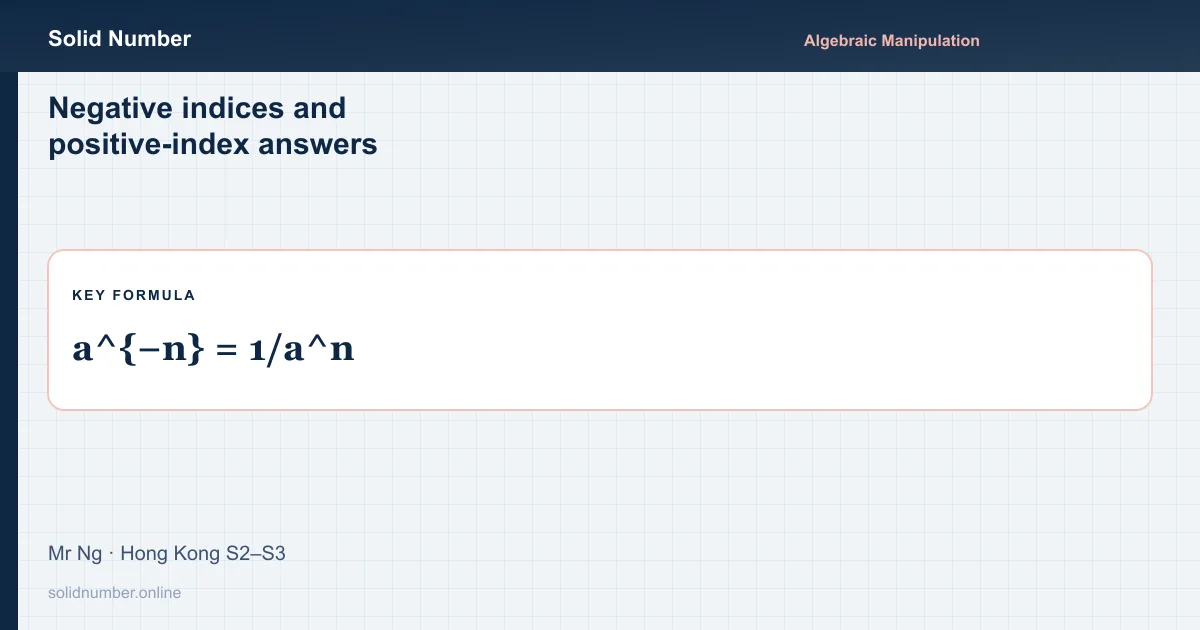
a^{−n} means 1/a^n for a ≠ 0. Negative indices are not “negative answers” — they are reciprocals of positive powers.
Combine then convert
Use the laws to combine indices while bases match. Only at the end convert any remaining negative index into a fraction with a positive index in the denominator (or a positive index on a reciprocal base).
Typical exam wording
“Simplify and express with positive index” appears often. An answer left as x^{−3} usually loses the final presentation mark.
Exam habit
Circle every negative index in the final line and rewrite it before stopping.
Worked example
Positive index form
Problem. Simplify x^{−4} · x^6 and express with a positive index.
Solution. x^{−4+6} = x^2 (already positive).
Review quiz
1 / 4x^{−4}·x^6 =
Practice questions
- Simplify x^{−4} · x^6 and express with a positive index.
- Simplify (2^3 · 2^{−5}) ÷ 2^{−1}.
- Simplify (3a^{−2})^2 and express with positive indices.
- Simplify (x^2 y^{−3}) / (x^{−1} y) with positive indices.
Study notes
Is 2^{−3} equal to −8?
No — 2^{−3} = 1/8.
What about (2x)^{−1}?
It equals 1/(2x), not 2/x or 1/2x with ambiguous juxtaposition — use brackets.