Reverse percentage problems
Recover the original value after a percentage change — classic exam reverse-percentage items.
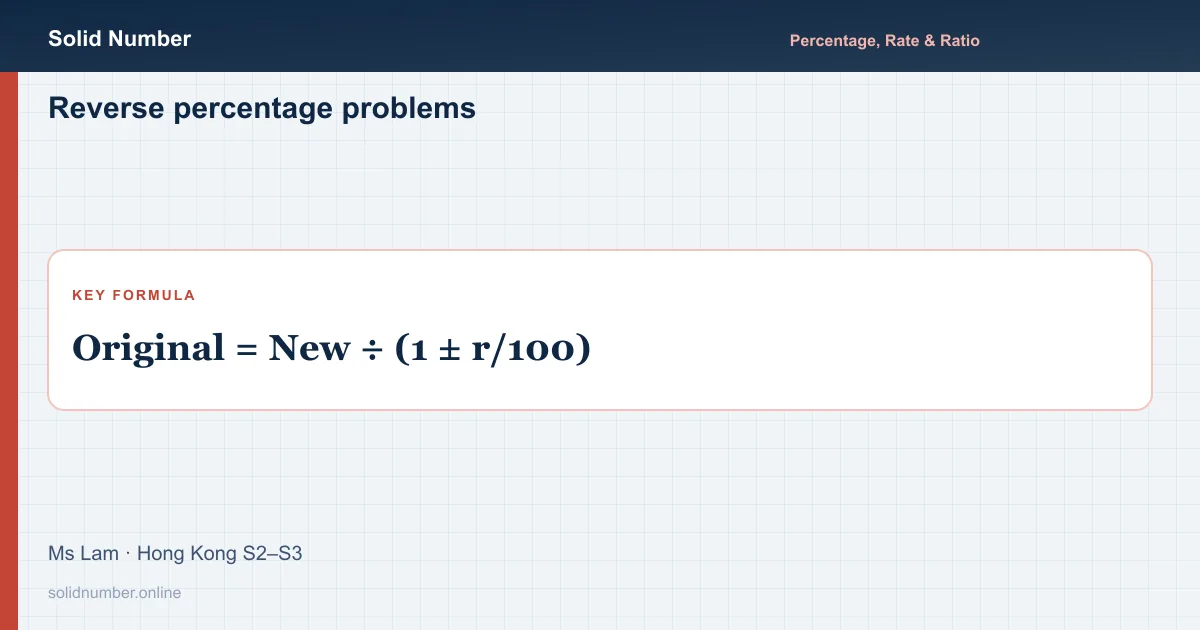
Key formulas
Why reverse percentage is not “subtract the %”
If a price rises 10% to $220, the original is not 220 − 10% of 220. The 10% was taken of the unknown original, so divide 220 by 1.10 to get 200.
Increase and decrease cases
After an increase of r%, divide by (1 + r/100). After a decrease of r%, divide by (1 − r/100). State the multiplier before dividing.
Successive reverse
If two changes happened, divide by each multiplier in reverse order (or by their product). Keep exact fractions until the end when possible.
Exam habit
Write “original × multiplier = new” then rearrange. Never take the percentage of the new value unless the question says so.
Worked example
Find the original
Problem. After a 15% increase a fee is $460. Find the original fee.
Solution. Original × 1.15 = 460 ⇒ original = 460 ÷ 1.15 = 400.
Review quiz
1 / 4After 15% rise a fee is $460. Original?
Practice questions
- After a 15% increase a fee is $460. Find the original fee.
- A phone sells for $3600 after a 20% discount. Find the marked price.
- A value falls 8% to 184. Find the original value.
- After a 10% rise and then a 5% rise, a salary is $23100. Find the salary before both rises.
Study notes
Is reverse percentage the same as percentage change?
No — percentage change finds the rate; reverse percentage finds the missing original.
Can the original be larger after a “decrease” reverse?
Yes — dividing by a factor less than 1 increases the number.
More in Percentage, Rate & Ratio
- Percentage increase and decrease
- Successive percentage changes
- Rate, ratio and direct proportion
- Percentage applications: discount, profit and simple interest
- Direct and inverse proportion
- Percentage word problems (exam style)
- Finding a percentage of a quantity
- Expressing one quantity as a percentage of another