Linear inequalities in one unknown
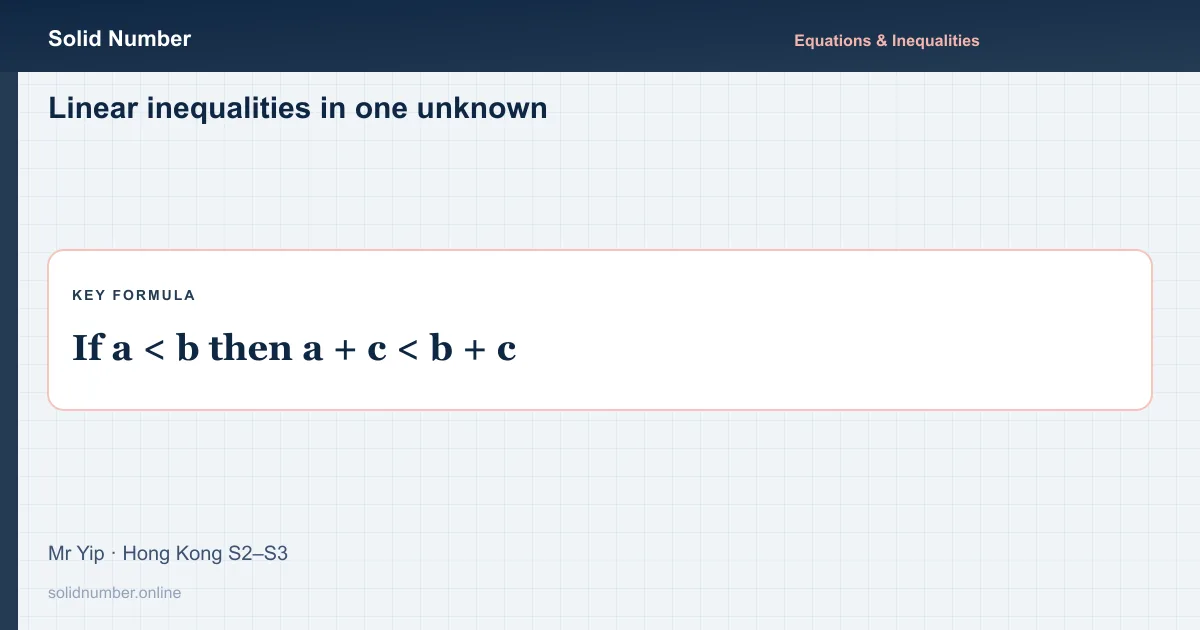
Solve and represent linear inequalities, remembering to flip the inequality sign when multiplying or dividing by a negative.
Key formulas
Same steps as equations — with one warning
You may add or subtract any number on both sides. You may multiply or divide by a positive number. If you multiply or divide by a negative number, reverse the inequality sign.
Representing solutions
Use number-line diagrams with open circles for < or > and closed circles for ≤ or ≥. In set notation, write solution sets clearly, e.g. x > 3.
Inequalities with brackets
Expand, collect terms, then isolate x. When dividing by a negative coefficient, flip the sign in the same step and highlight that flip.
Exam habit
Circle every multiplication/division by a negative so the sign flip is never forgotten.
Worked example
Flip the sign
Problem. Solve −2x + 3 > 11.
Solution. −2x > 8. Divide by −2 and flip: x < −4.
Review quiz
1 / 4Solve 2x + 5 < 13
Practice questions
- Solve 2x + 5 < 13 and show on a number line.
- Solve −3x ≥ 12.
- Solve 4 − 2x ≤ 10.
Study notes
Do I flip for −x > 4 when I multiply by −1?
Yes — multiplying by −1 reverses the inequality, giving x < −4.
Is x = 3 allowed for x > 3?
No. Use a filled circle only for ≤ or ≥.