Factorisation by grouping and common binomials
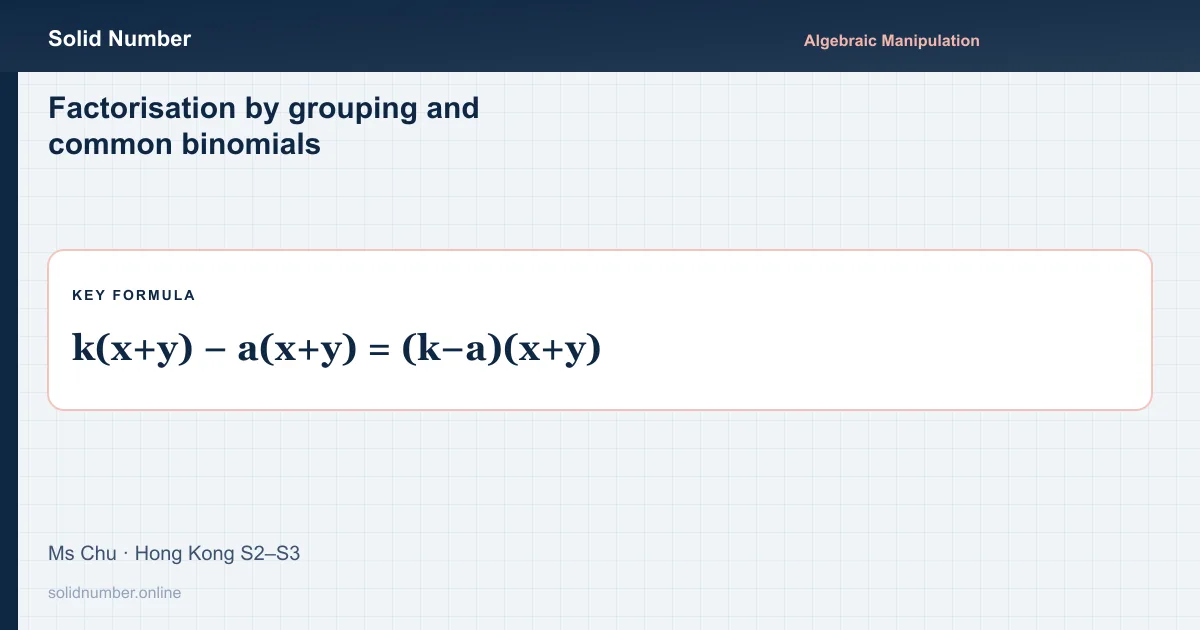
Factor expressions such as 5(x+y) − a(x+y) and four-term groupings.
Key formulas
Common binomial factor
If the same bracket appears in every term, take it out just like a common number. 5(x+y) − a(x+y) = (5 − a)(x+y).
Four-term grouping
Pair terms, factor each pair, then factor the repeated binomial. Rearrange if the first pairing fails.
Link to expansion
Assessment items often ask whether a step is factorisation or expansion. Factorisation creates brackets (usually); expansion removes them.
Exam habit
After grouping, if the brackets do not match, stop and regroup rather than forcing a wrong factor.
Worked example
Common bracket
Problem. Factorise 5(x + y) − a(x + y).
Solution. (5 − a)(x + y).
Review quiz
1 / 45(x+y)−a(x+y) =
Practice questions
- Factorise 5(x + y) − a(x + y).
- Factorise x³ + 2x² + 4x + 8.
- Factorise 3x(y − 2) + 5(y − 2).
- State whether “x² − 9 → (x−3)(x+3)” is expansion or factorisation.
Study notes
Can I factor a single term?
Only if a common factor is present across terms — one lone term is already “factored” only trivially.
Order of factors?
Any order is fine unless the question asks for a specific form.