Laws of integral indices
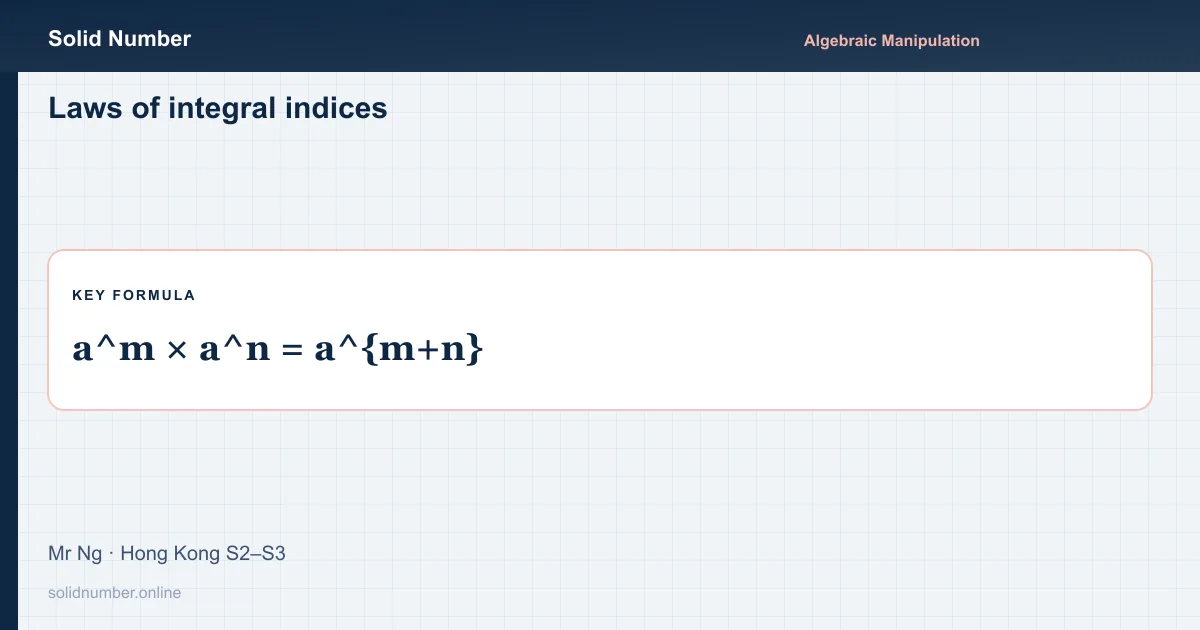
Master product, quotient, power and zero-index laws for Secondary 3 integral indices.
Key formulas
Same base is required
Index laws apply when bases match. Rewrite numbers as powers of the same base when possible: 8 = 2³, 9 = 3², 100 = 10².
Negative and zero indices
a^0 = 1 for a ≠ 0. A negative index means reciprocal: a^{−n} = 1/a^n. Do not confuse the sign of the index with the sign of the base.
Power of a product
(ab)^n = a^n b^n and (a/b)^n = a^n / b^n. Apply the outer index to every factor inside.
Exam habit
Convert everything to prime bases before combining indices. Finish by writing positive indices unless the question allows negative indices.
Worked example
Same-base simplification
Problem. Simplify (3^4 × 3^{−1}) ÷ 3^2.
Solution. 3^{4+(−1)} ÷ 3^2 = 3^3 ÷ 3^2 = 3^{1} = 3.
Review quiz
1 / 43^5 × 3^2 =
Practice questions
- Simplify 3^5 × 3^2 and 3^5 ÷ 3^2.
- Evaluate 5^{−2} and 7^0.
- Simplify (2^3)^4 × 2^{−5}.
Study notes
Is (−2)^0 equal to −1?
No. Any non-zero number to the power 0 equals 1, so (−2)^0 = 1.
How do I handle 2^3 × 4^2?
Write 4 as 2² so 4^2 = (2²)^2 = 2^4, then add indices: 2^3 × 2^4 = 2^7.
More in Algebraic Manipulation
- Simplifying algebraic expressions
- Identities and algebraic expansion
- Factorisation: common factors and grouping
- Factorising difference of squares
- Negative indices and positive-index answers
- Expanding binomials (exam practice)
- Factorising quadratics (cross method)
- Factorisation by grouping and common binomials