Linear inequalities (exam drills)
Solve inequalities with brackets and negative coefficients; represent solutions on a number line.
Key formulas
Same algebra, careful signs
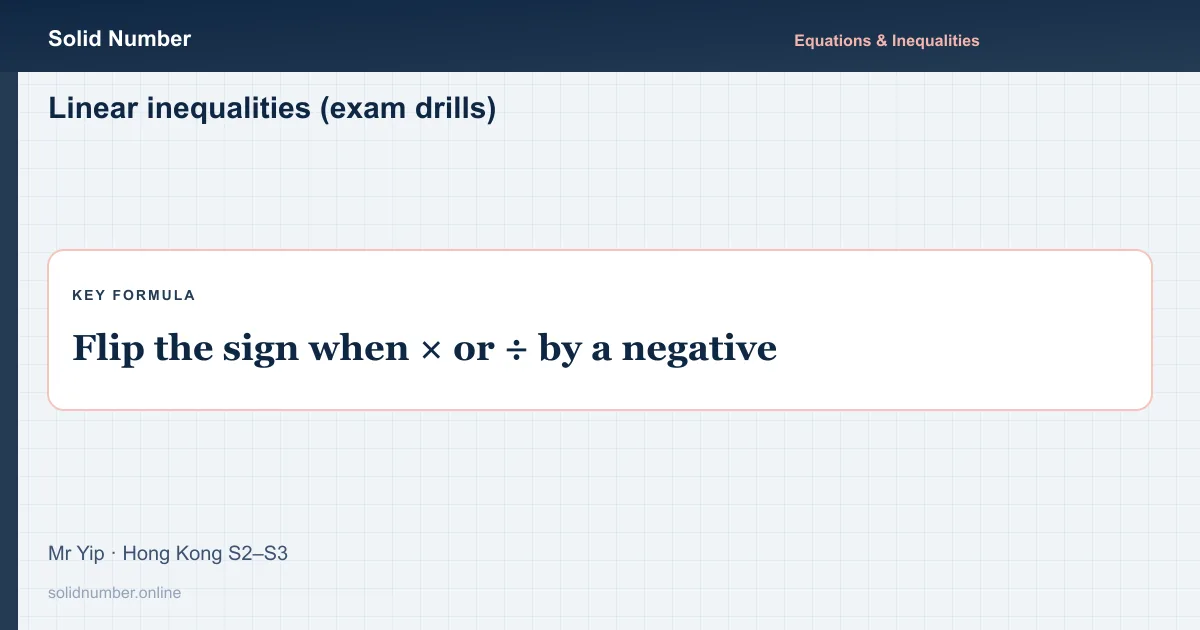
Expand brackets, collect terms, isolate x. The only extra rule: multiplying or dividing by a negative reverses the inequality.
Number-line answers
Many papers award a mark for a correct diagram. Use an open circle for strict inequalities and shade the correct ray.
Integer solutions
If the question asks for the largest integer x satisfying x < 3.2, the answer is 3 — inequality solutions are often more than a single value.
Exam habit
Highlight every division by a negative in red (or with a star) so the flip is never missed.
Worked example
Negative coefficient
Problem. Solve −5x ≤ 20.
Solution. Divide by −5 and flip: x ≥ −4.
Review quiz
1 / 4−5x ≤ 20 ⇒
Practice questions
- Solve 3(x − 2) > 2x + 5 and show on a number line.
- Solve −5x ≤ 20.
- Solve 7 − 4x ≥ 15.
- Find the largest integer x such that 2x − 1 < 10.
Study notes
Do I flip when moving terms across?
No — adding/subtracting the same amount never flips. Only ×/÷ by a negative flips.
Is x = 4 allowed for x ≥ 4?
Yes — closed circle.