Prime factorisation, HCF and LCM
Write numbers as products of primes, then read off HCF and LCM — a frequent TSA-style opener.
Key formulas
Prime factorisation
Break a whole number into a product of primes, often written with indices: 180 = 2² × 3² × 5. Listing factor trees or repeated division both work; the final form must use only primes.
HCF from prime factors
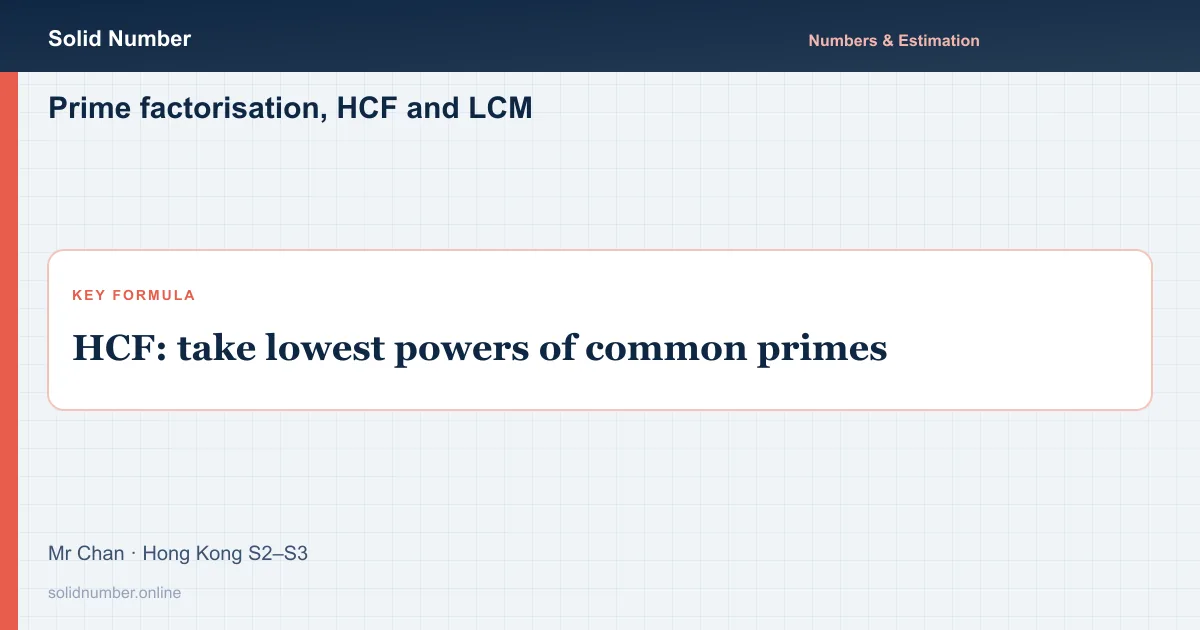
For two or more numbers, the highest common factor uses only the primes that appear in every factorisation, each raised to the lowest power that appears. Example style (numbers changed from typical papers): HCF of 2²×3 and 2×3²×5 is 2×3 = 6.
LCM from prime factors
The lowest common multiple uses every prime that appears in any factorisation, each raised to the highest power. LCM of 2²×3 and 2×3²×5 is 2²×3²×5 = 180.
Exam habit
Write each number in prime-factor form on its own line before comparing powers. Check: HCF × LCM = product of the two numbers when they are positive integers.
Worked example
HCF and LCM from primes
Problem. Find the HCF and LCM of 84 and 90.
Solution. 84 = 2²×3×7, 90 = 2×3²×5. HCF = 2×3 = 6. LCM = 2²×3²×5×7 = 1260. Check: 84×90 = 7560 and 6×1260 = 7560.
Review quiz
1 / 4HCF of 2²×3 and 2×3²×5 is
Practice questions
- Express 252 as a product of prime factors.
- Find the HCF and LCM of 84 and 90.
- Find the HCF of 2³×5² and 2×5×7.
- Two numbers are 2²×3×11 and 2×3³. Find their LCM.
Study notes
Is 1 a prime?
No. Prime factorisations never include 1 as a factor.
What if a prime is missing from one number?
It contributes power 0 to the HCF (so it is omitted) but its full power to the LCM.
More in Numbers & Estimation
- Directed numbers: add, subtract, multiply and divide
- Approximate values and sensible estimation
- Rational numbers: fractions, decimals and recurring decimals
- Scientific notation and large/small numbers
- Directed numbers with brackets (challenge)
- Ordering directed numbers on the number line
- Absolute value of directed numbers
- Four operations mixed with directed numbers