Identities and algebraic expansion
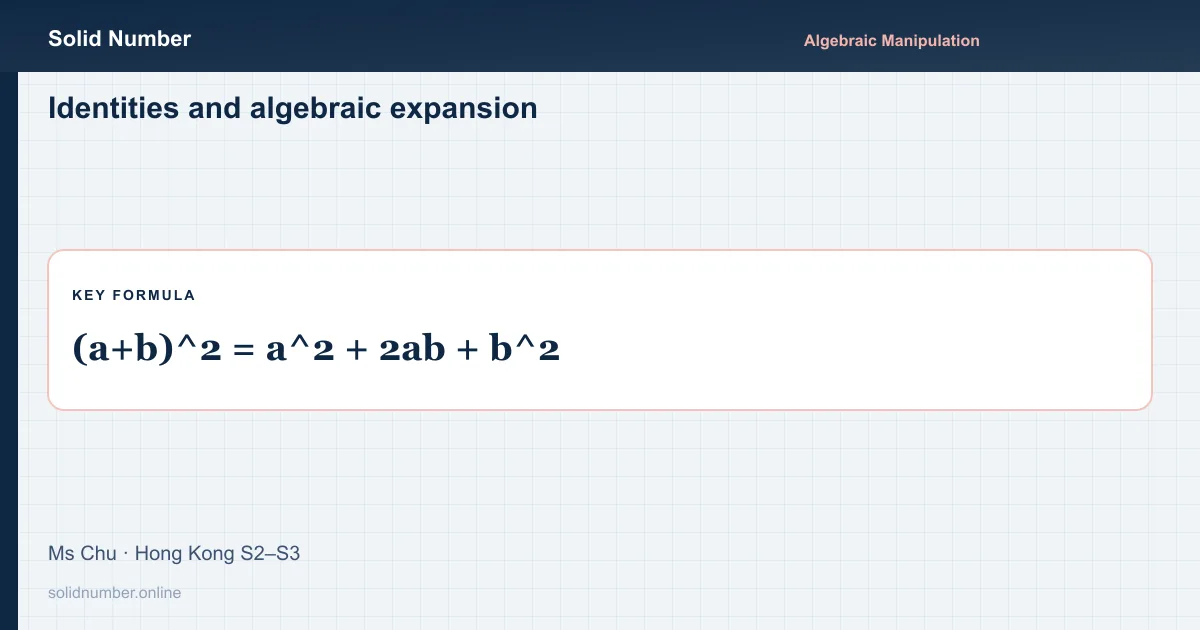
Use standard identities to expand quickly and to recognise structure in reverse for factorisation.
Key formulas
Identity versus equation
An identity is true for all admissible values of the variables. The three square and difference-of-squares identities should be memorised cold — they appear in almost every Secondary 3 algebra paper.
Expanding with identities
Match the pattern before expanding term by term. For (2x + 3)^2, take a = 2x and b = 3 to get 4x² + 12x + 9. Check the middle term: 2ab must use the actual a and b, including coefficients.
Difference of squares
(a + b)(a − b) expands to a² − b². Spotting this pattern saves time and prepares factorisation.
Exam habit
After expanding, mentally substitute a simple number (e.g. x = 1) to check both sides roughly.
Worked example
Square identity
Problem. Expand (5x − 2)^2.
Solution. a = 5x, b = 2. a² − 2ab + b² = 25x² − 20x + 4.
Review quiz
1 / 4(x+5)^2 =
Practice questions
- Expand (x + 5)^2 and (x − 5)^2.
- Expand (3x + 2)(3x − 2).
- Expand (2x − 7)^2.
Study notes
Is (a+b)^2 equal to a^2 + b^2?
No — the middle term 2ab is required.
Do identities need proving every time?
You may quote standard identities; expand from first principles if asked to prove.