Factorising quadratics (cross method)
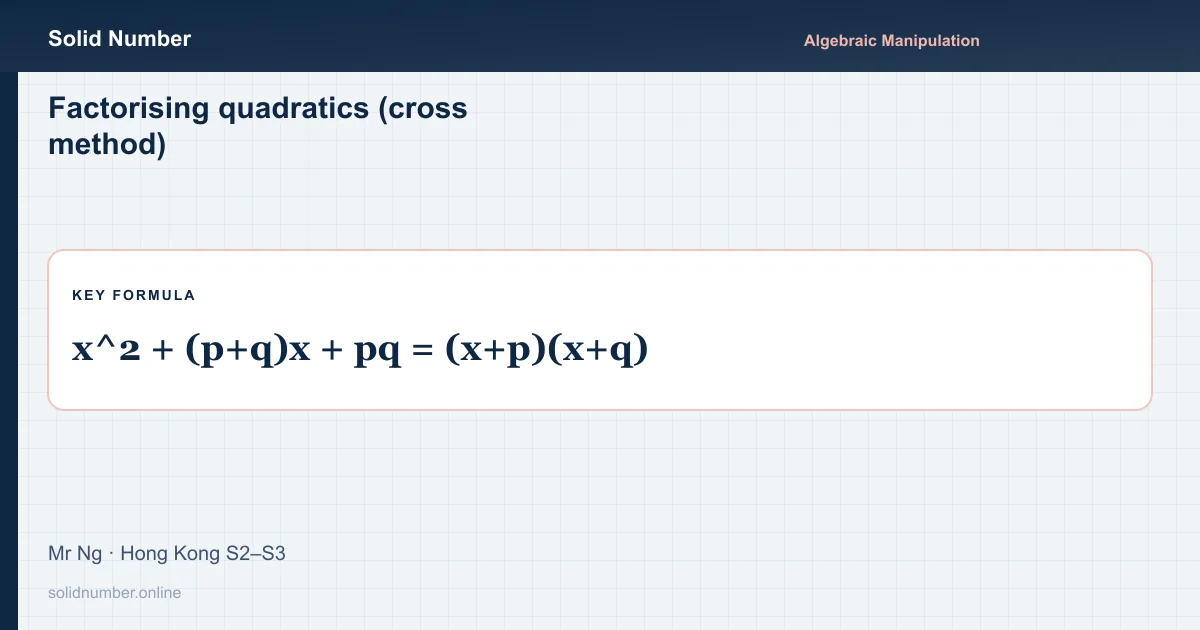
Factorise x² + bx + c and ax² + bx + c — a known weak area in S3 assessments.
Key formulas
When a = 1
Find two numbers that multiply to c and add to b. For x² − 7x + 6, the pair is −1 and −6 because (−1)+(−6)=−7 and (−1)(−6)=6, so (x−1)(x−6).
When a ≠ 1
Search for factor pairs of a×c whose signed sum is b, then split the middle term or use the cross method layout taught in class. Always take out a numerical common factor first if possible.
Perfect squares
x² + 12x + 36 = (x+6)². Recognising 36 = 6² and 12 = 2·6 saves time.
Exam habit
Expand your factors immediately to verify. If a ≠ 1, check the leading and constant terms first.
Worked example
Quadratic factors
Problem. Factorise x² − 7x + 6.
Solution. Need factors of 6 that add to −7: −1 and −6. So (x − 1)(x − 6).
Review quiz
1 / 4x²+12x+36 =
Practice questions
- Factorise x² + 12x + 36.
- Factorise x² − 7x + 6.
- Factorise x² + 5x − 14.
- Factorise 2x² + 7x + 3.
Study notes
What if no integer factors work?
In junior papers the numbers are chosen to work; recheck signs of the constant term.
Should I take out 2 first from 2x² + 4x + 2?
Yes — 2(x² + 2x + 1) = 2(x+1)².