Direct and inverse proportion
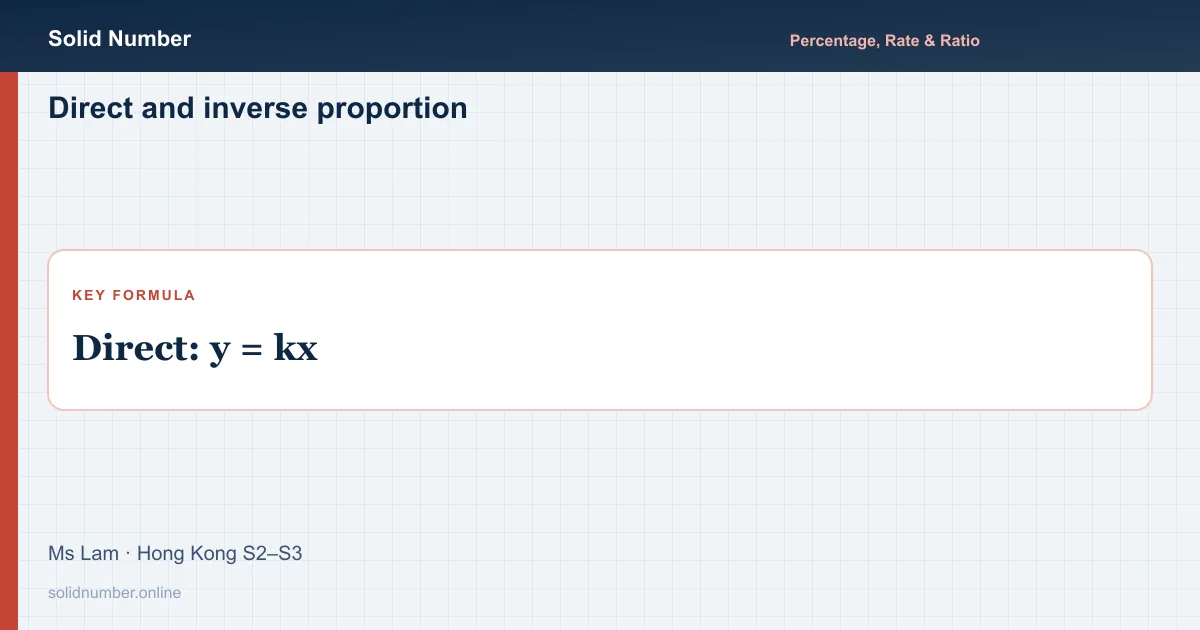
Decide whether y varies directly or inversely with x, then solve with k — TSA-style classification plus calculation.
Key formulas
Recognising the type
If doubling x doubles y, the relation is direct. If doubling x halves y (product constant), it is inverse. Word clues: “shared equally”, “speed and time for fixed distance” often signal inverse proportion.
Finding k
Use one known pair to find k, then substitute the new value. Keep units consistent — convert hours and minutes before forming rates.
Tables and graphs
Direct proportion graphs are straight lines through the origin. Inverse proportion graphs are rectangular hyperbolas in the first quadrant; the product of coordinates stays constant.
Exam habit
First write “direct” or “inverse” and the matching formula, then find k.
Worked example
Inverse proportion
Problem. y is inversely proportional to x. When x = 6, y = 10. Find y when x = 4.
Solution. k = xy = 60. When x = 4, y = 60/4 = 15.
Review quiz
1 / 4Direct: y=20 when x=8. y when x=14?
Practice questions
- y is directly proportional to x. When x = 8, y = 20. Find y when x = 14.
- y is inversely proportional to x. When x = 6, y = 10. Find y when x = 4.
- 12 workers finish a job in 10 days (same rate). How many days for 8 workers?
- State whether buying x identical pens for total cost y is direct or inverse.
Study notes
Is “more workers, fewer days” inverse?
Yes, if the total work is fixed and workers work at the same rate.
Does y = kx + 3 count as direct proportion?
No — direct proportion requires y = kx with no extra constant.
More in Percentage, Rate & Ratio
- Percentage increase and decrease
- Successive percentage changes
- Rate, ratio and direct proportion
- Percentage applications: discount, profit and simple interest
- Reverse percentage problems
- Percentage word problems (exam style)
- Finding a percentage of a quantity
- Expressing one quantity as a percentage of another