Percentage applications: discount, profit and simple interest
Apply percentage tools to discount, profit/loss and simple interest — standard Secondary 2–3 applications.
Key formulas
Profit and loss
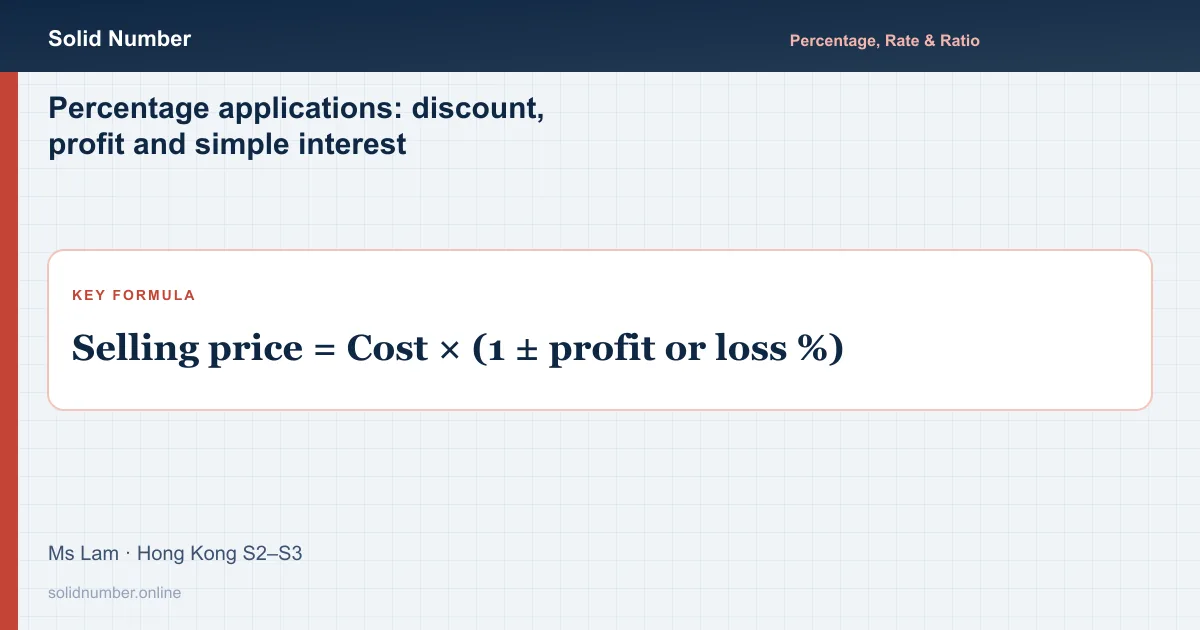
Profit percentage uses cost price as the base unless the question states otherwise. Selling price = cost × (1 + profit%/100) or cost × (1 − loss%/100).
Discount
A discount is a percentage of the marked price. Sale price = marked price × (1 − discount%/100). If two discounts apply successively, multiply the two discount multipliers.
Simple interest
Simple interest I = PRT/100 when R is a percentage per year and T is in years. Total amount = principal + interest. Convert months to years before substituting.
Exam habit
Identify the base of every percentage — cost, marked price or principal — before calculating.
Worked example
Simple interest
Problem. Find the simple interest on $6000 at 5% per annum for 2 years.
Solution. I = 6000 × 5 × 2 / 100 = 600. Interest is $600; amount is $6600.
Review quiz
1 / 4Cost $800, 15% profit. Selling price?
Practice questions
- Cost $800, sold at 15% profit. Find the selling price.
- Marked $1200 with 25% discount. Find the sale price.
- Principal $5000 at 4% per year for 3 years. Find the simple interest.
Study notes
Is compound interest in S2–S3?
Many schools introduce simple interest first; compound interest may appear later. This lesson stays with simple interest.
Profit on selling price?
Rare in junior papers — assume cost price unless stated.