Rate, ratio and direct proportion
Express ratios in simplest form, share quantities, and solve direct proportion problems with clear units.
Key formulas
Ratio language
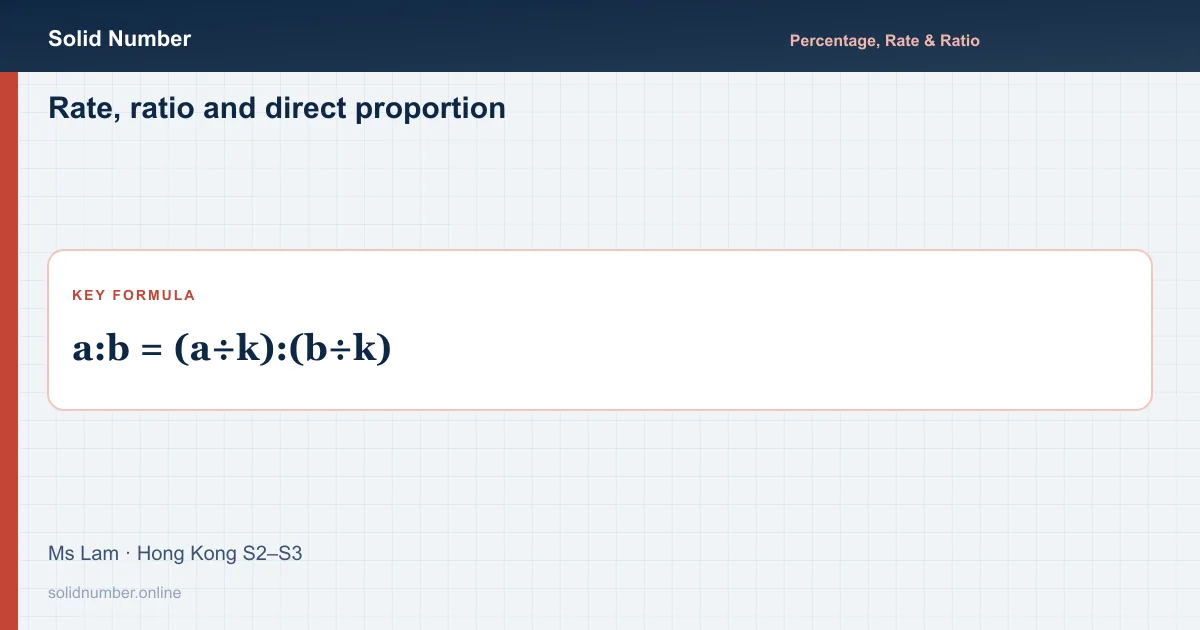
A ratio a:b compares two quantities of the same type. Simplify by dividing both parts by their highest common factor. Keep units consistent before forming a ratio — convert minutes to hours or cm to m first if needed.
Sharing in a ratio
To share an amount in the ratio a:b, find the total number of parts a + b, find the value of one part, then multiply. Check that the shares add back to the original amount.
Rate and direct proportion
A rate compares different types of quantity, such as km/h or $/kg. If y is directly proportional to x, then y = kx for some constant k. Find k from one pair, then use it for other values.
Exam habit
Write units beside every rate. For proportion, state y = kx before substituting.
Worked example
Share in a ratio
Problem. Share $960 in the ratio 5:7.
Solution. Parts = 12. One part = 960/12 = 80. Shares = 400 and 560. Check: 400 + 560 = 960.
Review quiz
1 / 4Simplify 36:48
Practice questions
- Simplify the ratio 36:48.
- Share $420 in the ratio 3:4.
- If y is directly proportional to x and y = 15 when x = 6, find y when x = 10.
Study notes
Is 2:3 the same as 2/3?
2:3 compares parts; 2/3 is a single fraction. Related ideas, different notation.
What is inverse proportion?
When the product xy stays constant — covered later; here we focus on direct proportion.