Successive percentage changes
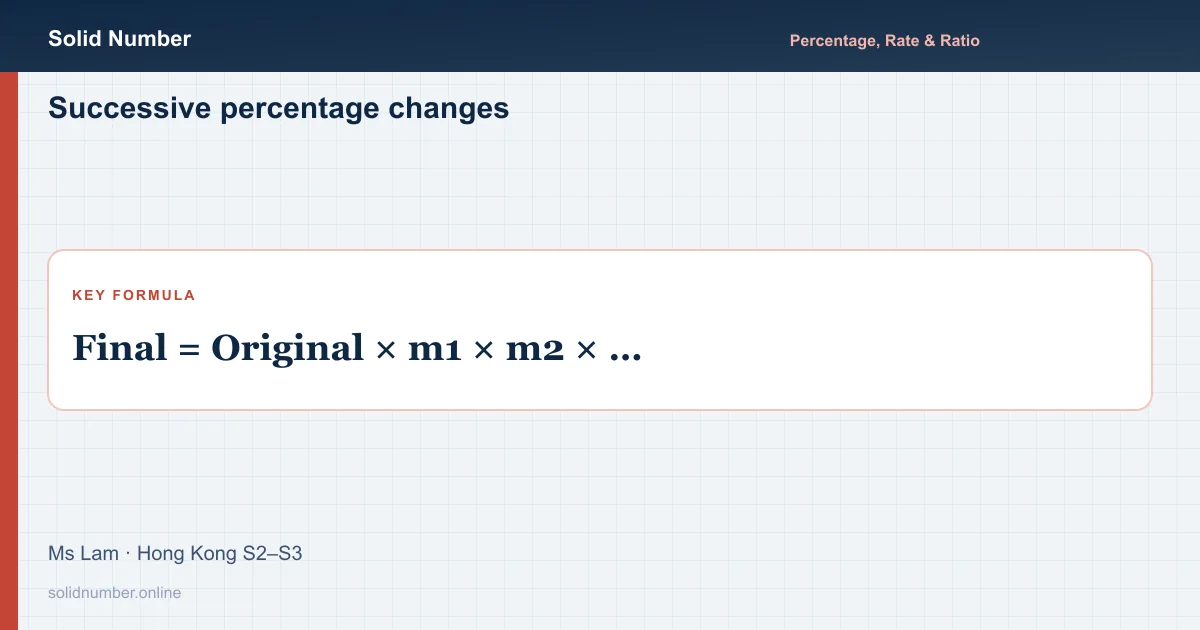
Combine successive percentage changes by multiplying multipliers — never by adding the percentages.
Key formulas
Why you multiply multipliers
Each percentage change acts on the result of the previous stage. If Stage 1 uses m1 and Stage 2 uses m2, the overall multiplier is m1 × m2. Adding the percentage rates is wrong except in the special case of tiny rates used as rough estimates.
Mixed increase and decrease
A shop marks up 30% then offers 10% off: overall multiplier = 1.3 × 0.9 = 1.17, so a 17% overall increase on the cost price — not a 20% increase.
Finding an equivalent single change
Compute the product of multipliers, then convert (overall multiplier − 1) × 100% into a single percentage increase, or (1 − overall multiplier) × 100% into a single percentage decrease.
Exam habit
List each multiplier on its own line, multiply, then interpret the final multiplier in words.
Worked example
Up then down
Problem. A value increases by 20% then decreases by 20%. Find the overall percentage change.
Solution. Multipliers 1.2 and 0.8. Product = 0.96. Overall change = 4% decrease.
Review quiz
1 / 4Rise 10% then 10%. Overall multiplier?
Practice questions
- A salary rises 8% then 5%. Find the overall percentage increase.
- A price rises 25% then falls 20%. Find the overall percentage change.
- After two equal percentage increases the value is 1.44 times the original. Find each increase.
Study notes
Can I add 8% and 5%?
No for exact work. 1.08 × 1.05 = 1.134, which is a 13.4% rise, not 13%.
Does order matter?
For pure percentage multipliers, order does not change the final product.
More in Percentage, Rate & Ratio
- Percentage increase and decrease
- Rate, ratio and direct proportion
- Percentage applications: discount, profit and simple interest
- Reverse percentage problems
- Direct and inverse proportion
- Percentage word problems (exam style)
- Finding a percentage of a quantity
- Expressing one quantity as a percentage of another