Expanding binomials (exam practice)
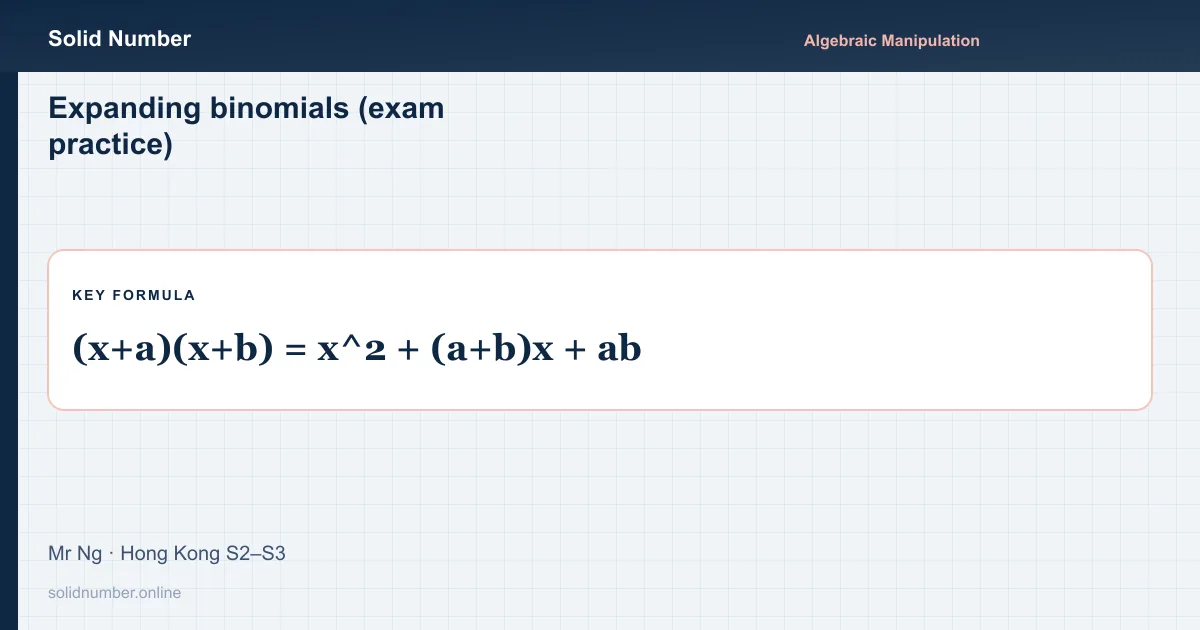
Expand products such as (x−1)(x+5) and arrange polynomials in descending powers of x.
Key formulas
FOIL or distributive law
Multiply each term in the first bracket by each term in the second. Collect like terms. For (x−1)(x+5): x² + 5x − x − 5 = x² + 4x − 5.
Descending powers
Papers often ask which polynomial is written in descending powers of x. Order from highest power to constant term: 3x³ − x + 2 is descending; 2 − x + 3x³ is not.
Identity check
After expanding, substitute a simple value (e.g. x = 2) into both the factored and expanded forms to catch arithmetic slips.
Exam habit
Write four product lines when unsure, then combine — slower but safer under pressure.
Worked example
Expand two brackets
Problem. Expand (x − 1)(x + 5).
Solution. x² + 5x − x − 5 = x² + 4x − 5.
Review quiz
1 / 4(x−1)(x+5) =
Practice questions
- Expand (x − 1)(x + 5).
- Expand (2x + 3)(x − 4).
- Expand (x − 3)².
- Arrange 5 − 2x³ + 7x in descending powers of x.
Study notes
Is expansion the reverse of factorisation?
Yes — that relationship is tested in classification items.
Do I need the middle term for (x+a)(x+b)?
Yes — (a+b)x must appear unless a + b = 0.