Linear equations in one unknown
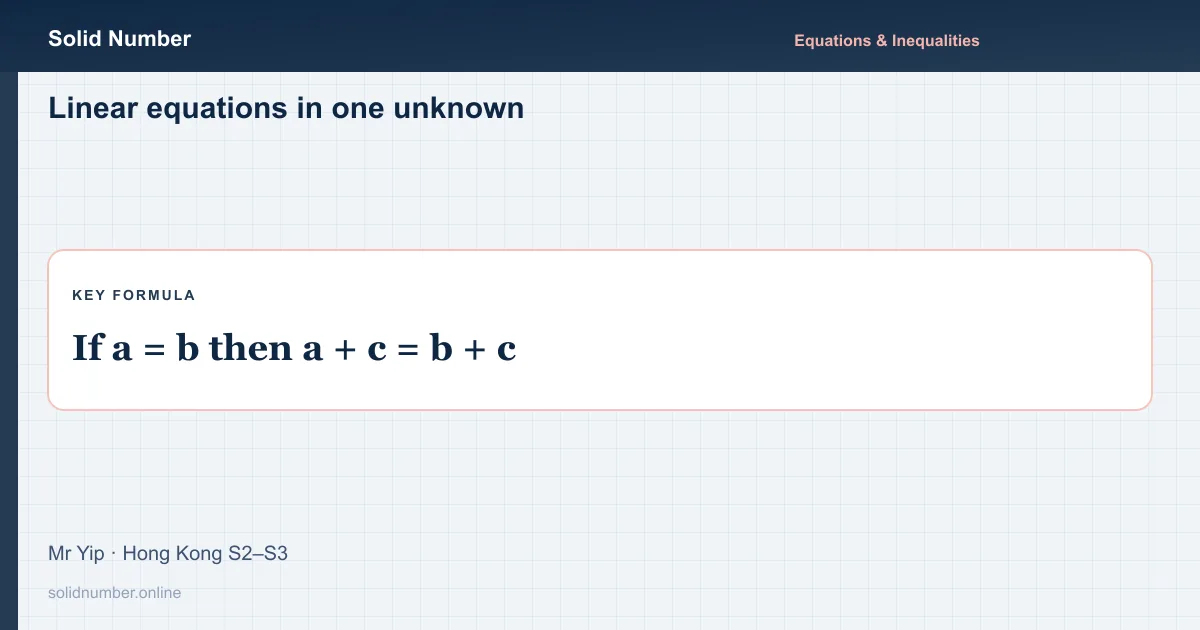
Solve linear equations with brackets and fractions using balanced steps and clear checking.
Key formulas
Balance principle
Whatever you do to one side, do to the other. Prefer inverse operations: undo addition with subtraction, undo multiplication with division.
Brackets and fractions
Expand brackets first, or clear fractions by multiplying through by the LCM of denominators. Collect unknown terms on one side and constants on the other.
Checking
Substitute your solution back into the original equation. A check takes seconds and catches arithmetic errors before marks are lost.
Exam habit
Number each transformation. Never cancel terms that are added rather than multiplied.
Worked example
Clear fractions
Problem. Solve (2x)/5 − 1 = 3.
Solution. Add 1: (2x)/5 = 4. Multiply by 5: 2x = 20. x = 10. Check: 20/5 − 1 = 3.
Review quiz
1 / 4Solve 3x − 7 = 11
Practice questions
- Solve 3x − 7 = 11.
- Solve 2(x + 4) = 3x − 1.
- Solve (x/3) + 5 = 9.
Study notes
What if the variable disappears?
If you get a true statement (e.g. 0 = 0), every number works; if false (e.g. 0 = 5), there is no solution. Linear S2–S3 questions usually have one solution.
Should I use a calculator?
Keep exact fractions unless the paper asks for decimals.