Percentage increase and decrease
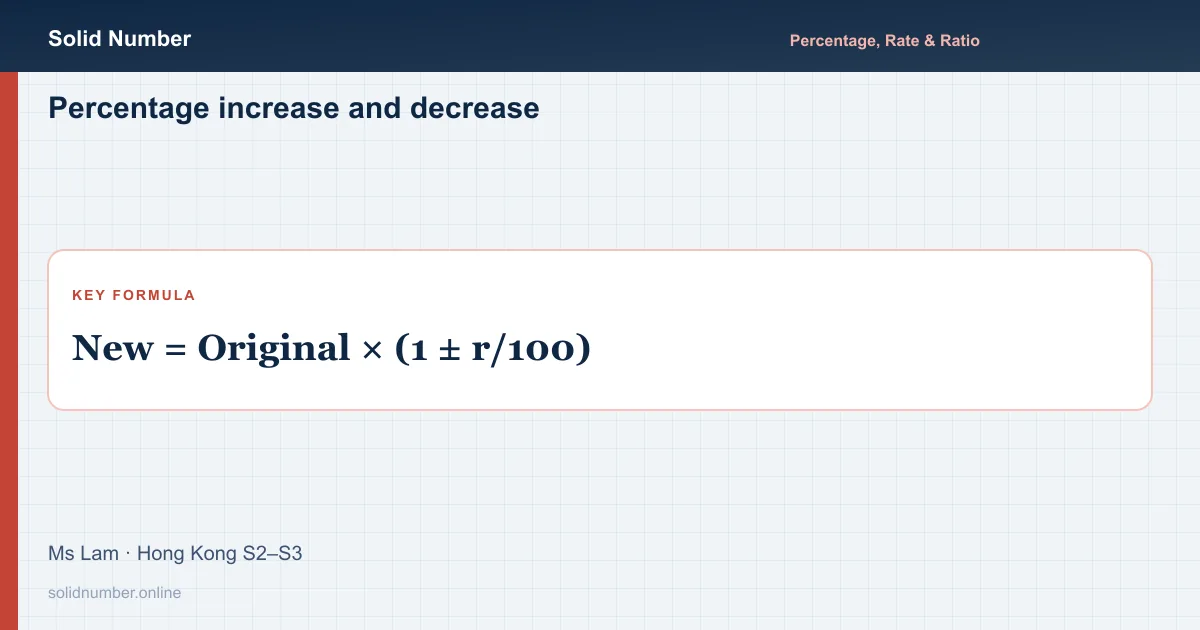
Convert between percentages and multipliers so increase and decrease problems stay consistent.
Key formulas
The multiplier idea
An increase of r% multiplies the original by (1 + r/100). A decrease of r% multiplies by (1 − r/100). Working with multipliers is faster and reduces arithmetic slips compared with finding the change separately every time.
Finding the percentage change
Percentage change equals (actual change ÷ original value) × 100%. Always divide by the original, not the new value, unless the question asks for reverse percentage.
Common traps
A 20% increase followed later by a 20% decrease does not return to the original — successive changes use different bases. Also, “increased by 20% of A” is not the same wording as “increased to 20% of A”.
Exam habit
Underline original and new. Write the multiplier before substituting numbers.
Worked example
Increase with multiplier
Problem. A phone priced at $4800 rises by 7.5%. Find the new price.
Solution. Multiplier = 1.075. New price = 4800 × 1.075 = 5160. The new price is $5160.
Review quiz
1 / 4Increase 200 by 15%. New value?
Practice questions
- A price of $250 increases by 12%. Find the new price.
- A quantity falls from 80 to 68. Find the percentage decrease.
- A value increases by 15% to become 460. Find the original value.
Study notes
What is reverse percentage?
You are given the new value and the percentage change; divide by the multiplier to recover the original.
Can the multiplier exceed 2?
Yes — a 120% increase uses multiplier 2.2.
More in Percentage, Rate & Ratio
- Successive percentage changes
- Rate, ratio and direct proportion
- Percentage applications: discount, profit and simple interest
- Reverse percentage problems
- Direct and inverse proportion
- Percentage word problems (exam style)
- Finding a percentage of a quantity
- Expressing one quantity as a percentage of another