Rates in everyday contexts
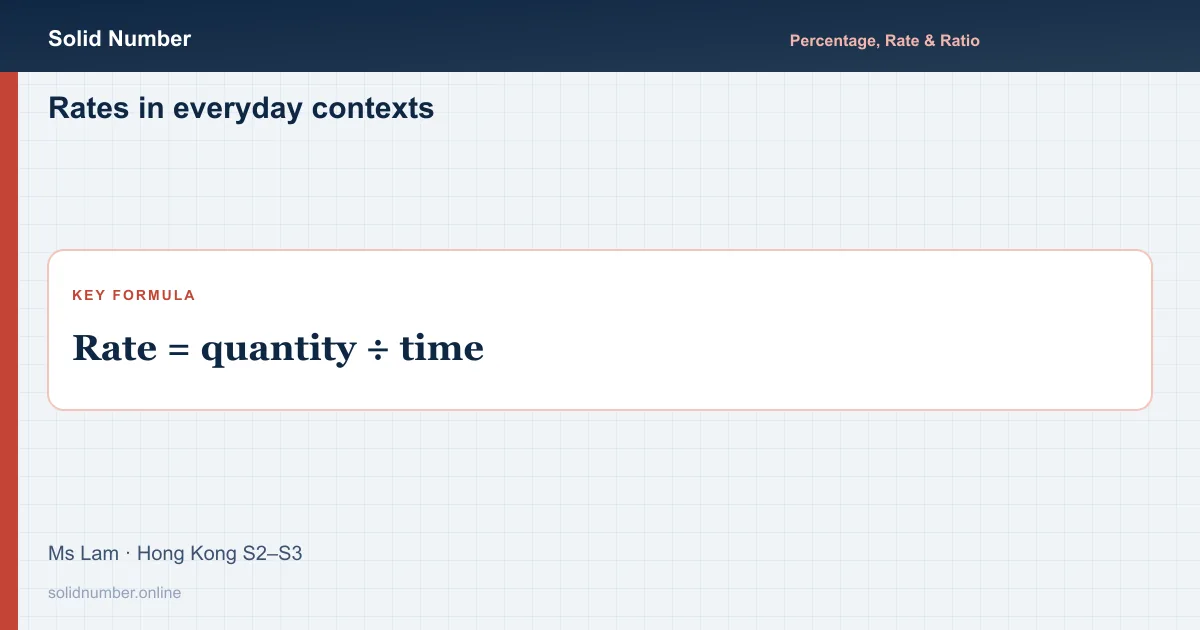
Work with speed, unit price and currency-style rates with units.
Key formulas
What this lesson covers
This lesson builds Secondary 2–3 skill in everyday rates. Read the key formulas, study the worked example, then attempt the written practice and the four-question MCQ review.
Method
Write every step. Name the rule you use (everyday rates) before substituting numbers. Keep units and signs visible until the final sentence.
Common mistakes
Students often rush the sign, use the wrong percentage base, or cancel terms instead of factors. Pause after each line and ask whether the step is reversible.
Exam habit
Underline the question verb (simplify, solve, factorise, find). Box the final answer and, where sensible, substitute back for a quick check.
Worked example
Worked example — everyday rates
Problem. Apply the method for everyday rates with the numbers 8 and 3.
Solution. Identify the rule for everyday rates. Substitute 8 and 3 carefully with signs in brackets if needed. Complete each operation on a new line. State the final answer clearly and check by reversing one step.
Review quiz
1 / 4Warm-up on everyday rates: what is 5+3?
Practice questions
- Practice 1 on everyday rates: compute with the value 26.
- Practice 2 on everyday rates: change the numbers and repeat the same method.
- Practice 3 on everyday rates: write one sentence explaining the key rule.
- Practice 4 on everyday rates: invent a similar exam-style question and solve it.
Study notes
What is the main idea of everyday rates?
Apply the stated formula or rule with clear steps, then check by reversing or substituting.
How should I revise this topic?
Cover the worked example, redo the practice without notes, then complete the MCQ set and log any wrong options.